Australia Has Made Mining Safer — But Hand Exposure Remains
Australia operates one of the world's most sophisticated mining industries. Automation, remote operations, advanced lifting systems, engineered access, improved guarding and increasingly mature critical-risk programmes have changed the way mines manage serious hazards.
Yet one of the oldest forms of workplace exposure remains remarkably persistent: the worker's hand is still being used as the final interface between the job and the hazard.
A load is moved mechanically — but a person reaches in to steady it.
A component is suspended from a crane — but someone puts a hand on it for the last few centimetres of alignment.
A sling or chain is released — but a worker reaches underneath to retrieve it.
A pipe is mechanically lifted — but hands are used to stop it rolling.
A pin is driven — but fingers remain close to the striking point.
These actions can appear routine because they happen every day. But from a hand-exposure perspective, they share something important: the worker's hand has become part of the control system.
How do we protect the hand during contact? Gloves, impact protection, cut resistance. Essential — but addresses exposure after the hand is already in the hazard zone.
Can we reduce or eliminate the contact? Redesign the task, introduce a mechanical interface, increase the stand-off distance. Addresses the reason the hand was there.
These are not competing approaches. Mining needs both. But the engineering question is being asked far less often than it should be.
The Real Question: Why Was the Hand There?
After a hand injury, investigations naturally examine procedures, positioning, PPE, competency and individual actions. There is another question worth asking much earlier:
"Why did the task require a hand to enter that location at all?"
Consider a suspended component being lowered into position. The crane provides the lifting force. The rigging carries the load. The operator controls movement. Yet during the final 300 mm of positioning, a worker reaches toward the load to rotate it slightly.
At that moment, a sophisticated mechanical lifting system has effectively handed its final control function back to the human hand.
The same pattern appears throughout mining: machine movement → final manual intervention → hand exposure. This is why hand safety cannot be treated only as a PPE problem. It is also a task-design problem.
The Last 300 mm
Many tasks are highly mechanised until the final stage. A load travels 20 metres by crane. The final 200 mm is guided by hand. A component weighing hundreds of kilograms is mechanically removed. The last alignment is performed with fingers.
"Those final few centimetres may contain the greatest concentration of hand exposure in the entire operation. The last 300 mm of load travel is not the moment to rely on instinct — it is the moment where the engineering must be most reliable."
The objective is not to claim that every mining activity can become completely hands-free. The objective is to identify situations where the hand is being used as a guide, a stopper, an alignment device, a retrieval device, a pushing surface, a stabiliser — and then ask: can a purpose-designed interface perform that function while the worker remains farther from the hazard?
Where Engineering Can Change the Outcome
These five zones cover the most consistent hand-exposure patterns across Australian mining operations. Each represents a task family where an engineered interface — not a better glove — is the appropriate next step.
Suspended Loads
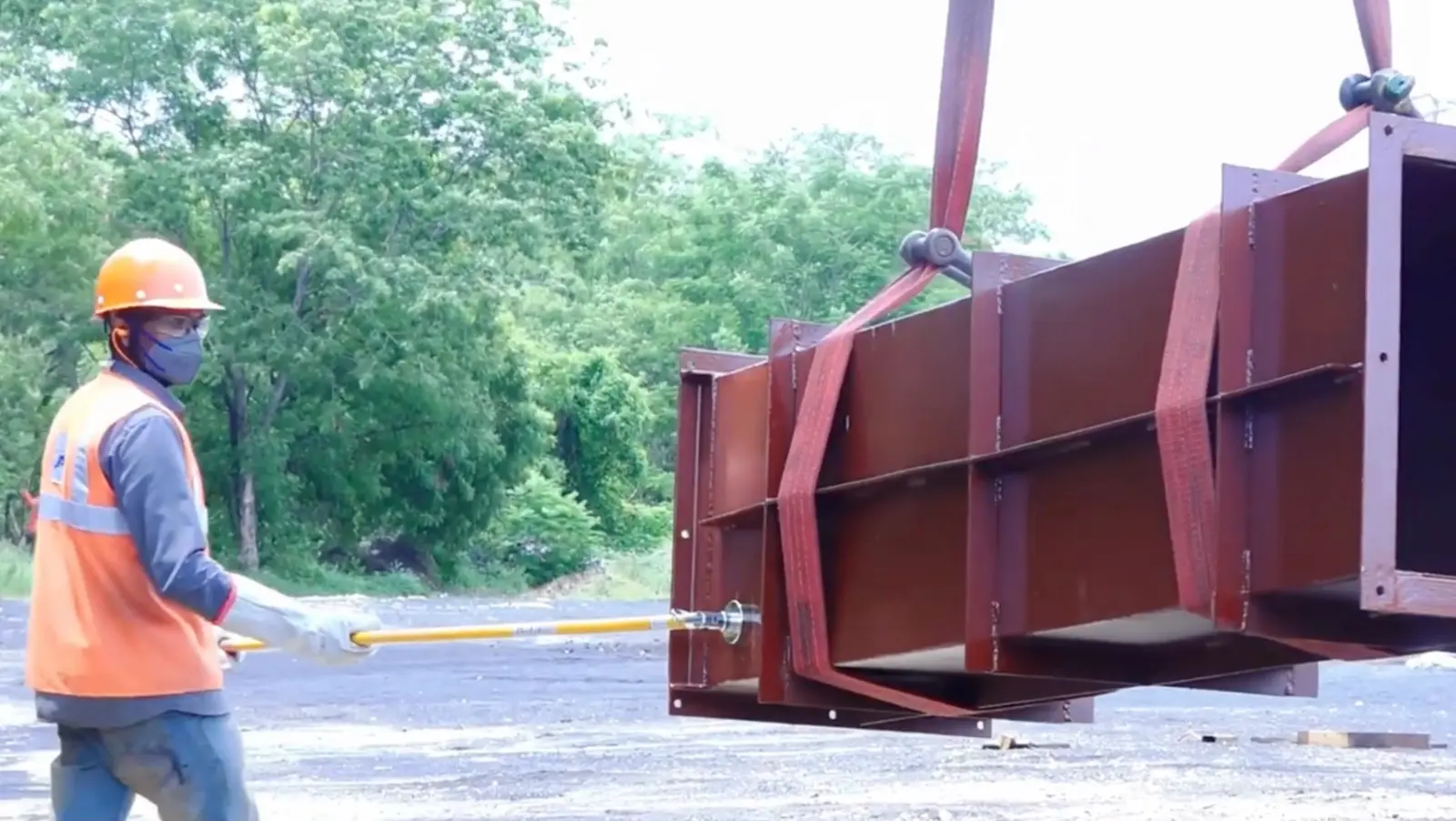
Workers instinctively want to control a load that rotates, drifts or approaches its landing position. Placing a hand directly onto a suspended load introduces exposure to unexpected movement, stored energy and pinch or crush zones.
Where the task permits, the preferred approach should be to create separation between the person and the load — maintaining the control function while moving the hand away from the load's surface.
Tagline Handling & Retrieval
A tagline can increase separation from a suspended load — but poor tagline management introduces its own hazards. Workers may approach the load to retrieve a fallen line. Hands may release or reposition a tagline close to the load after landing.
The engineering question should extend beyond "are we using a tagline?" to: "can the complete tagline operation be performed while maintaining appropriate worker separation?"
Pipe, Tubular & Cylindrical Loads
Pipe presents a particular hand-safety challenge because it can roll, rotate and shift unexpectedly. The temptation to steady cylindrical material manually is strong — particularly during loading and unloading, workshop maintenance, pipe-rack activities and equipment assembly.
The round surface offers no natural resistance to rotation. If the component shifts in grip, the hand may roll or slide into the path of the rolling component or into an adjacent structure.
Magnetic Retrieval & Positioning
Steel-intensive mining environments create opportunities to use magnetic interfaces where workers would otherwise reach toward ferrous components — guards, covers, panels, wear liners. The conventional handling method is a hand grip on the panel edge, concentrating drop-crush risk at the worker's grip points.
If the task requires contact with steel, the hand does not necessarily have to provide that contact.
Striking, Pin & Punch Operations
A familiar exposure occurs when one worker holds a punch, pin or chisel while another uses a hammer. The holder's fingers may be only millimetres from the impact zone. This task typically involves one worker holding the struck tool while another delivers hammer blows — with no defence against striker fatigue or unexpected tool movement.
The engineering question is simple: can the holding function be provided by a tool rather than by a person's hand?
From PPE Thinking to Exposure Thinking
The hierarchy of controls applied to hand exposure — not as a compliance exercise, but as an engineering sequence.
A Practical Hand-Exposure Audit
A useful mine-site review can be surprisingly straightforward. Observe the task. Find the hand. Ask what it is doing — and whether it needs to be there.
- Touch or steady suspended loads
- Guide components into position by hand
- Retrieve chains, slings or taglines near loads
- Reach beneath or alongside equipment
- Hold objects during striking or impact
- Push material or pull equipment into alignment
- Place fingers between two mating surfaces
- Steady cylindrical or tubular components
- Grip flat steel panels by the edge
- Say "we have always done it this way"
- Where exactly is the hand during this task?
- What function is the hand performing?
- What can move, crush, strike or trap near it?
- Can that function be moved away from the hand?
- Is there a tool that could provide that function?
- Has it been assessed — or just accepted as normal?
Some tasks will have practical solutions. Some may require a different work method. Some may not have a hands-off solution at all. That is why task-level assessment is more valuable than simply distributing tools across a site.
Australian Mining Is Well Positioned to Lead the Next Step
Australia already has the safety systems, engineering capability and operational maturity needed to take hand safety beyond conventional PPE programmes. The injury data tells us why the issue deserves attention.
Queensland's RSHQ has explicitly emphasised reducing hand exposure and recognised the limitations of relying on gloves against serious crush, fracture and amputation mechanisms. The next evolution does not require another slogan.
It requires looking closely at work.
Sometimes the answer will be yes. But when the answer is no, there is an opportunity to engineer the exposure out of the task. That is where serious hand-injury prevention moves beyond PPE — and becomes engineering.
PSC Hand Safety India
PSC works with mining, resources and heavy-industry operations to identify recurring hand-exposure tasks and evaluate practical stand-off, load-control, magnetic, retrieval, pipe-handling and striking solutions.
Rather than selecting equipment from a catalogue first, sites can share task photographs, short videos or descriptions of the exposure for an initial application review. Solutions are then field-trialled and evaluated with operators and HSE teams before wider implementation.
From reading to application
Describe the task, the moving load and the point where hands approach the hazard. Use the PSC catalogue to identify the relevant function, then request selection support.
Browse PSC & HSF tools ↗ · Australian sources and further reading ↗